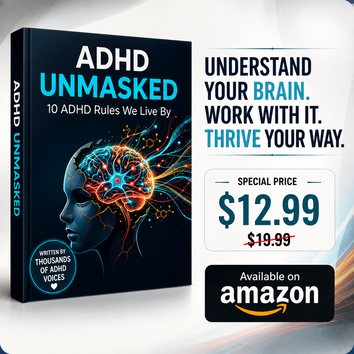


ADHD Unmasked: 10 ADHD Rules We Live By is an ambitious and highly distinctive addition to the growing world of ADHD books. Rather than approaching ADHD primarily as a clinical condition or presenting another conventional productivity system, the book attempts to describe the everyday experience of living with an ADHD brain from the inside. Its central idea is that many people with ADHD spend their lives trying to operate according to rules designed for a different kind of brain. The author therefore presents the book as an informal “Operating System” for ADHD, built around ten recurring patterns involving stimulation, motivation, memory, urgency, procrastination, decision-making, body doubling and interest.
What immediately separates this book from many other ADHD titles is its voice. It does not sound like a medical textbook, and it does not try to maintain the detached tone of a traditional psychology guide. Instead, it speaks directly to the reader with humor, exaggeration, frustration and recognition. The book repeatedly takes ordinary experiences that people with ADHD may have been criticized for throughout their lives and reframes them as patterns that can be understood and worked with. That approach gives the manuscript considerable emotional power because its underlying message is not simply “here is how to become more productive,” but rather “here is why some of the things you have been blamed for may make more sense than you thought.”
The strongest concept running through the book is the idea of an ADHD Operating System. This gives the manuscript a unifying identity that many books in this category lack. Instead of presenting ten unrelated pieces of advice, the author tries to build a coherent framework around the way attention, stimulation, environment and urgency interact. Concepts such as the “Two-Task Minimum,” the “D.O.O.M. Pile,” “Procrastivity,” the “Urgency Engine,” “Body Doubling” and the “INCUP Framework” become part of a vocabulary that readers can carry with them after finishing the book. That is a significant strength. A good self-help book does not merely give information; it gives readers language with which to understand their own lives.
📚 Interested in reading the full book? Get your copy of ADHD Unmasked on Amazon KDP and discover the 10 rules for understanding your ADHD brain. ADHD unmasked
The first chapter, The Paradox of Peace, is a particularly effective example. The book explores the experience of needing background stimulation while watching television, listening to something while trying to sleep, fidgeting during meetings or doing another low-level activity while concentrating on a primary task. The author turns this into the idea of a “Two-Task Minimum,” arguing that some people with ADHD find it easier to concentrate when a second, relatively low-demand activity occupies part of their attention. The community quotations included throughout the chapter make the observation feel lived rather than theoretical. Whether every neurological explanation attached to the phenomenon is fully supported by research is another matter, but as a description of a recognizable ADHD experience, the chapter is compelling.
The chapter on Organized Chaos and the D.O.O.M. Pile may be one of the book’s most useful sections. The author challenges the conventional assumption that better organization always means hiding things away in drawers, cabinets and containers. For someone who relies heavily on visual reminders, putting something into an opaque storage system can sometimes make the item effectively disappear from awareness. The book therefore recommends visible storage, clear containers, open shelving and low-friction drop zones. The “D.O.O.M. Pile,” meaning “Didn’t Organize, Only Moved,” is an especially memorable piece of terminology because it transforms what looks like ordinary clutter into a recognizable organizational strategy. The underlying principle is simple: if the environment itself can function as external memory, organization should support that memory rather than erase it.
The chapter on Productive Procrastination is another major strength. One of the book’s most interesting observations is that procrastination does not always look like doing nothing. Sometimes a person avoids one difficult task by becoming extraordinarily productive at everything else. Someone might spend hours cleaning the house, reorganizing a room or completing minor tasks while continuing to avoid a three-minute email that carries emotional or psychological friction. The book calls this “Procrastivity,” and the term works because it captures a very specific experience. The person is not necessarily avoiding work itself; they are avoiding one particular kind of work. That distinction is psychologically useful and gives the reader a much more nuanced way of thinking about procrastination.
The Urgency Engine is probably one of the most relatable concepts in the entire manuscript. The book describes the familiar ADHD experience of spending days unable to begin something and then suddenly producing an extraordinary amount of work when the deadline becomes immediate. The “11:59 Phenomenon” is presented as a recognizable pattern rather than simply laziness or poor planning. What makes this section stronger is that the author does not romanticize the phenomenon completely. The manuscript also discusses the crash that can follow prolonged periods of high-pressure performance. In that sense, the book recognizes both the apparent strength and the hidden cost of relying on urgency.
The chapter on Unwritten Hacks and Survival Tactics continues the book’s strongest theme: changing the environment instead of endlessly trying to change the person. The “Shoes On” rule, external alarms, visible timers, the “Sacred Doorway Bowl” and other environmental strategies all follow the same philosophy. Instead of demanding more willpower, the book asks whether the environment can be redesigned so that fewer executive-function decisions are necessary. This is one of the manuscript’s most practical ideas because it moves the discussion away from abstract motivation and toward physical systems that can actually be changed.
The Co-Pilot’s Guide is particularly valuable because it expands the book beyond the individual with ADHD. Many ADHD books focus almost entirely on the person experiencing the symptoms, but relationships are where ADHD-related difficulties can become extremely complicated. The manuscript examines the frustration of partners who feel forced into the role of manager, reminder, scheduler or rescuer. Its recommendation that partners become more like “Sous-Chefs” than managers is an interesting metaphor for collaborative support. The section on natural consequences is also important because it recognizes that constant rescuing can create resentment on one side and dependency on the other.
The chapters on Choice Paralysis, Body Doubling and the Interest-Based Nervous System complete the book’s conceptual structure effectively. Choice paralysis is presented as the experience of becoming overwhelmed when too many options compete for attention. Body doubling describes the strange but widely reported experience of becoming much more capable of starting a task simply because another person is present. The final chapter then returns to the idea that interest, novelty, challenge, urgency and personal meaning can be more powerful motivators than abstract importance. Together, these chapters reinforce the central philosophy of the book: instead of endlessly demanding that an ADHD brain behave like a conventional productivity system, build an environment in which the brain’s existing motivational patterns can actually be used.
This is where ADHD Unmasked becomes particularly interesting in comparison with established books in the ADHD market. Russell Barkley’s Taking Charge of Adult ADHD, for example, occupies a much more authoritative and clinically structured position. Barkley’s book covers evaluation, executive functions, treatment, medication, work, money, relationships and other areas of adult life, and its publisher describes it as a science-based resource. It has also sold more than 225,000 copies.
ADHD 2.0 by Edward M. Hallowell and John J. Ratey occupies another major position in the market. It combines scientific discussion with strategies and lifestyle approaches designed to minimize ADHD difficulties while maximizing strengths. Its appeal comes partly from the authors’ professional authority and their emphasis on finding environments in which ADHD characteristics can become assets rather than simply treating them as problems.
Jessica McCabe’s How to ADHD is perhaps the closest contemporary comparison in terms of tone and accessibility. It is explicitly described by its publisher as an honest, friendly and shame-free guide based on the author’s experiences and practical strategies. McCabe’s established public platform also gives that book an enormous advantage in terms of visibility and credibility.
Then there is You Mean I’m Not Lazy, Stupid or Crazy?!, the classic adult ADHD self-help title by Kate Kelly and Peggy Ramundo. The book has been in the market for decades and has more than a quarter-million copies in print according to its publisher. Its central emotional achievement was giving adults with ADHD a language for understanding themselves without automatically interpreting their difficulties as laziness, stupidity or moral failure.
Compared with these established books, ADHD Unmasked does not currently have the same level of clinical authority, historical reputation or publishing infrastructure. It should not attempt to compete with Barkley on scientific comprehensiveness or with established bestselling authors on professional authority. Its opportunity is different. Its strongest position is as a community-driven, highly readable field guide to the everyday experience of ADHD.
That distinction is important because the manuscript’s greatest strength is also its greatest weakness. The book is extremely confident in explaining why certain ADHD behaviors happen. It frequently moves from a recognizable community observation to a neurological explanation involving dopamine, the Default Mode Network, object permanence, the amygdala, mirror neurons, arousal, reward systems and executive function. Some of these concepts are legitimately relevant to ADHD research, but the manuscript sometimes presents complicated scientific ideas as if they were settled explanations for individual behaviors.
This is the main area I would improve before publication. The problem is not that the book uses metaphors. In fact, the metaphors are some of its greatest strengths. The “Hunter,” “Farmer,” “Ferrari,” “tractor,” “Background Toddler” and “Operating System” language makes complicated experiences understandable. The problem arises when a metaphor is presented as though it were a literal description of ADHD neuroscience. A stronger version of this book would clearly distinguish between what ADHD community members commonly report, what the author is using as a metaphor, what research suggests and what remains uncertain.
The same issue applies to some of the book’s absolute statements. ADHD is highly heterogeneous, and not every person with ADHD requires two simultaneous activities, experiences severe visual-memory problems, responds to urgency in the same way or benefits from body doubling. The book would become more credible if some statements changed from “the ADHD brain does this” to “many people with ADHD experience this.” That small adjustment would not weaken the book. In fact, it would make its argument stronger because it would acknowledge the diversity of ADHD rather than suggesting that every person with the diagnosis shares one neurological operating system.
There is also an opportunity to add references without destroying the personality of the manuscript. The book currently feels deliberately community-driven, and that should remain its identity. But because it repeatedly invokes scientific explanations, a properly researched references section would add significant credibility. Short “What the research says” sections could also be added after major concepts. The reader could then clearly see where the book is describing lived experience, where it is proposing an interpretation and where established research exists.
Despite those limitations, the manuscript’s emotional impact is considerable. Its repeated insistence that “different” does not automatically mean “broken” is not merely motivational language. It is the emotional foundation of the entire book. The author understands that many adults with ADHD have spent years being told that their problems are evidence of laziness, irresponsibility, carelessness or lack of effort. By reframing these experiences as patterns that can be understood and accommodated, the book offers something that purely clinical explanations sometimes struggle to provide: recognition.
The humor also gives the book a major advantage. Terms such as “D.O.O.M. Pile,” “Pocket Purgatory,” “Procrastivity,” “Urgency Engine,” “Social Hostage,” “Sacred Doorway Bowl” and “Two-Task Minimum” are memorable precisely because they are slightly ridiculous. They turn frustrating experiences into concepts that can be discussed without shame. That gives the book a strong potential for word-of-mouth sharing because readers can easily imagine sending a particular concept to a partner or friend and saying, “This is exactly what I do.”
Ultimately, ADHD Unmasked feels less like a traditional ADHD textbook and more like a collective survival manual. It does not attempt to provide every piece of information someone could possibly need about ADHD. Instead, it concentrates on the strange everyday mechanics of living with an ADHD brain and tries to create a language around those experiences. That narrower focus is actually one of its strengths.
My overall rating for the manuscript in its current form would be 8.4 out of 10. For originality and voice, I would place it around 8.8 out of 10. For practical usefulness, it deserves around 9 out of 10, because many of its environmental and behavioral strategies are immediately understandable and usable. For readability and entertainment value, I would give it around 9.1 out of 10. Where it falls behind established ADHD books is scientific rigor, where I would currently give it around 6.8 out of 10, primarily because some neurological explanations are presented too confidently and would benefit from stronger sourcing and qualification.
With a careful scientific fact-check, better references and a clearer distinction between metaphor and established neuroscience, I believe the manuscript could realistically move into the 9/10 range as a popular ADHD self-help book. Importantly, I would not recommend stripping away its humor or community voice in the process. Those are precisely the qualities that make it different from more clinical books already occupying the market.
The most important thing this book has going for it is that it does not simply tell the reader how to manage ADHD. It tries to explain why a person with ADHD can look completely irrational from the outside while their behavior makes perfect sense from the inside. That is a powerful premise, and the book has enough original language, practical ideas and emotional recognition to make that premise memorable.
Final verdict: ADHD Unmasked is an energetic, highly relatable and unusually distinctive ADHD book with genuine potential. It is not yet the most scientifically rigorous book in its category, but it does not need to be. Its strongest contribution is its attempt to turn the chaotic everyday experience of ADHD into a recognizable operating system—one that readers can understand, adapt to and, perhaps for the first time, stop apologizing for.
📚 Interested in reading the full book? Get your copy of ADHD Unmasked on Amazon KDP and discover the 10 rules for understanding your ADHD brain. ADHD unmasked