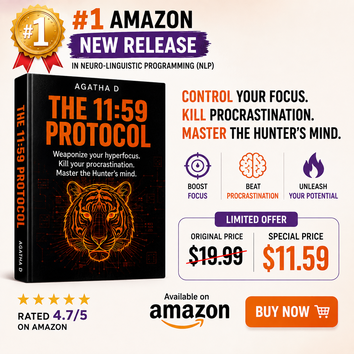


The 11:59 Protocol: Weaponize Your Hyperfocus. Kill Your Procrastination. Master the Hunter’s Mind. is a very different kind of ADHD book. It does not present itself as a conventional psychology guide, clinical handbook or gentle productivity manual. From the opening pages, it deliberately adopts the language of a manifesto, challenge and psychological reset program. The reader is not simply asked to understand ADHD; they are challenged to act, immediately.
The book’s central idea is built around a powerful metaphor: the Hunter versus the Farmer. The Hunter represents a mind that responds strongly to novelty, urgency, challenge, stimulation and immediate consequences, while the Farmer represents the predictable, patient, repetitive structure that modern schools, workplaces and conventional productivity systems often demand. The book argues that many people with ADHD spend their lives believing they are broken because they are constantly trying to function inside systems that do not match the way they experience motivation and attention.
What makes The 11:59 Protocol particularly distinctive is its tone. This is not a book that gently tells the reader to create a morning routine, write down their goals and try to be more disciplined. It deliberately uses extreme language—death, survival, weapons, hunting, war, cages, explosions and rebirth—to create urgency. The recurring 11:59 PM deadline becomes the central psychological device. The reader is asked to imagine that the old version of themselves ends at midnight and that the person who wakes up the following morning has been given a “Bonus Life.”
That concept gives the book an unusual narrative structure. Instead of reading like ten independent chapters of advice, it feels like a progression through levels of a game. The reader moves from the System Crash, through the Identity Shift, into the Survival Kit, and finally toward the Reboot and Bonus Life. This gaming language is especially appropriate for the book’s target audience because it transforms productivity from an abstract obligation into a sequence of missions, challenges and immediate wins.
The opening chapter, “The Gun and the Clock,” establishes the book’s philosophy immediately. The hypothetical gun-to-the-head scenario is intentionally provocative: if a task genuinely had to be completed within one hour to survive, would the reader still scroll through social media or tell themselves they would start tomorrow? The book uses that thought experiment to introduce its main argument about urgency. When consequences become immediate, the author’s “Hunter” suddenly becomes focused. The problem, therefore, is not necessarily the absence of ability but the difficulty of activating that ability without sufficient urgency.
The 11:59 PM deadline is arguably the book’s most original narrative device. Rather than simply telling readers that deadlines can help, the entire book becomes one giant deadline. Midnight represents the symbolic death of the old identity, while the next morning represents a reset. This gives the reader a reason to keep moving through the chapters because the book itself is structured like a countdown. That is a clever publishing concept because the title, cover, narrative and exercises all reinforce the same central idea.
Another particularly effective concept is the Ferrari Engine and Bicycle Brakes metaphor. The book suggests that a person can possess enormous mental speed and creative potential while simultaneously struggling with initiation, distraction and executive control. The metaphor communicates that contradiction instantly. Someone can have extraordinary ideas, intense interests and periods of extreme concentration while being unable to begin a simple administrative task. The book turns that apparent contradiction into one of its central arguments: the problem may not always be the engine; sometimes it is the braking system.
The book’s Dopamine Menu is one of its more practical ideas. Instead of simply telling readers to stop using their phones, it asks them to prepare alternative sources of stimulation in advance. Short activities become “Starters,” longer activities become the “Main Course,” and entertainment becomes “Dessert.” The important insight here is that telling someone with ADHD to stop seeking stimulation without providing an alternative may be unrealistic. The book therefore tries to redirect the search for stimulation rather than eliminate it completely.
The Airplane Mode War takes this idea further by introducing what the manuscript calls the Noise Pyramid. Digital notifications form the base, social pressure sits in the middle and future anxiety forms the top. Together, these layers are presented as a constant stream of competing demands on attention. The proposed response is deliberately aggressive: disconnect, remove unnecessary input and create a temporary island of isolation in which the reader works on one important task.
The 5-Minute Rule is perhaps the most immediately practical chapter. The book correctly identifies a familiar problem: sometimes the greatest difficulty is not completing a task but starting it. A huge task can feel psychologically impossible before any action has taken place. By reducing the commitment to five minutes, the reader is asked to remove the psychological barrier associated with the entire project. The book then introduces micro-tasks and the idea that a tiny first victory can create momentum toward the next action.
The chapter on Singletasking is another strong section because it challenges the idea that constantly switching between tasks represents productivity. The Tiger metaphor is used effectively here: rather than chasing ten deer simultaneously, the Hunter selects one target and commits to it. The book then turns that metaphor into the Rule of 3, asking the reader to identify three priorities rather than attempting to complete an overwhelming list of ten or twenty tasks.
The Time Blindness chapter fits naturally into the overall system because time itself becomes one of the book’s enemies. The recommendation to make time visible through visual timers is particularly compatible with the book’s larger philosophy. Instead of asking the reader to maintain an abstract awareness of passing time, the book wants time to become something visible and concrete. The disappearing timer becomes another form of artificial urgency.
Body Doubling is also a strong inclusion. The book presents the presence of another person as a form of accountability and social scaffolding. Rather than requiring the other person to teach, supervise or assist, the person simply works alongside the reader. This is not merely a quirky productivity trick; body doubling is now an area of active interest in research and design for ADHD support, although the evidence base is still developing. A 2026 research framework specifically describes body doubling as a self-management technique used by adults with ADHD while also highlighting the need for further empirical research into how and why it works. (arXiv)
The final psychological shift occurs in The Shame Spiral, where the book moves away from productivity and toward identity. This is arguably the most emotionally important part of the manuscript. The author argues that repeated failures can become incorporated into a person’s identity until “I failed at something” becomes “I am a failure.” The book then introduces radical forgiveness and the symbolic destruction of the old identity. The idea of writing down past failures and physically tearing up the paper is designed as a psychological ritual marking a transition rather than simply another productivity exercise.
The final chapter, The Bonus Life, completes the book’s central metaphor. Midnight arrives, nothing physically explodes, and the reader realizes that the “death” was symbolic. The old identity is considered finished, and the reader is invited to approach the following day as an additional life rather than a continuation of yesterday’s failures. The daily reset—ending one identity at night and beginning again in the morning—is one of the book’s strongest philosophical ideas.
In the current ADHD book market, The 11:59 Protocol would occupy a very different position from established titles such as Russell Barkley’s Taking Charge of Adult ADHD. Barkley’s book is a much more comprehensive, science-based resource covering diagnosis, treatment, medication, executive functioning, relationships, time management and adult life. Its publisher currently lists more than 225,000 copies in print and describes it as a science-based guide with practical tools. (Guilford Press)
The difference is important. Taking Charge of Adult ADHD is designed to educate and guide. The 11:59 Protocol is designed to activate. Barkley’s book has the advantage when the reader wants clinical authority, comprehensive information and evidence-based management. The 11:59 Protocol has the advantage when the reader already understands their struggles and wants something that feels more like a psychological kick-start.
The manuscript also enters the territory occupied by books specifically targeting ADHD procrastination. For example, The Procrastination Playbook for Adults with ADHD, published by Jessica Kingsley Publishers in 2024, focuses directly on identifying different forms of procrastination and provides interactive tools and personalized strategies. (Google Play) The 11:59 Protocol is much more aggressive and narrative-driven by comparison. It does not simply analyze procrastination; it attempts to make the reader emotionally uncomfortable enough to act.
That is the book’s greatest commercial advantage—and also its greatest risk.
The strongest thing about The 11:59 Protocol is its voice. It is memorable. It is impossible to confuse with a conventional ADHD workbook. “The clock is ticking,” “The cage is broken,” “You are a Hunter,” “The old you is dead,” “Bonus Life,” “Airplane Mode War,” “Dopamine Menu,” “5-Minute Rule,” and “Body Doubling” create a vocabulary that gives the book a recognizable identity. The reader is not merely consuming information; they are being invited into a fictionalized psychological world.
However, the manuscript also has a serious weakness that should be addressed before publication: some of its scientific claims are presented too confidently. The book repeatedly describes ADHD as though it were essentially a Hunter brain designed for danger and urgency, while contrasting it with a Farmer brain that represents the majority of people. It also makes categorical claims about dopamine, adrenaline, hyperfocus, time blindness, evolutionary history, multitasking and neurological mechanisms. These are engaging explanations, but several are better understood as metaphors or simplified interpretations rather than established scientific facts.
The Hunter vs. Farmer concept is excellent as a metaphor, but it should not be presented as a literal evolutionary explanation for ADHD. Likewise, saying that ADHD is “not a disorder” but a “superpower” is emotionally powerful but scientifically and clinically too absolute. ADHD is a recognized neurodevelopmental disorder, and although people with ADHD can absolutely possess strengths associated with creativity, intense interest, adaptability and other characteristics, those strengths do not erase the impairments that ADHD can cause.
This distinction matters because the book is strongest when it says, “You are not morally broken.” It becomes weaker when that message turns into “ADHD is not a disorder at all.” The first statement can be deeply empowering. The second risks oversimplifying a complex condition.
The same applies to the book’s repeated claim that ADHD brains simply need dopamine or that urgency directly creates hyperfocus. These ideas can be useful shorthand for discussing motivation and attention, but the underlying neuroscience is considerably more complicated. The manuscript would become much stronger if it retained the dramatic metaphors while clearly labeling them as metaphors and avoiding claims that sound like established neurological laws.
There is also a safety issue with some of the book’s dramatic exercises. The “gun,” “death,” “heart stops,” “lock the door,” and “burn the paper” imagery is deliberately theatrical, but it should be handled carefully. The underlying psychological exercise can remain intense without encouraging readers to treat death as a literal motivational tool or to isolate themselves in ways that could be unsafe. The book’s “island” exercise, for example, would be stronger if it explicitly said that readers should remain reachable for genuine emergencies and should not lock themselves away if doing so creates a safety concern.
These changes would not require turning the book into a boring clinical manual. In fact, doing that would destroy what makes it interesting. The better approach would be to preserve the Hunter, Tiger, War, Game and Bonus Life language while adding occasional reality checks that distinguish motivational metaphor from scientific evidence.
As a market proposition, however, the concept is genuinely interesting. Most ADHD books try to help readers understand their brains, build systems, improve executive function or develop healthier routines. The 11:59 Protocol attempts something different: it creates a high-intensity motivational experience around ADHD. It feels closer to a personal challenge or mental training program than a traditional self-help book.
That gives it a potentially strong audience among adults who have already read conventional ADHD advice and are tired of hearing the same recommendations. Someone who has repeatedly written planners, downloaded productivity apps, created morning routines and promised themselves that “tomorrow will be different” may find the book’s aggressive approach refreshing. Instead of another ten-step productivity system, the book says: stop waiting for the perfect system and create an immediate hunt.
The book also has strong potential for digital content and community building because almost every major concept can become a standalone piece of content. “Are you a Hunter or a Farmer?” can become a quiz. “What’s on your Dopamine Menu?” can become a social post. “Try the 5-Minute Rule.” “Do you suffer from the 11:59 phenomenon?” “Who is your Body Double?” “What is your Noise Pyramid?” These concepts naturally translate into videos, social posts, quizzes and interactive challenges.
That gives The 11:59 Protocol something that many conventional books do not have: a built-in content ecosystem.
My overall rating for the manuscript in its current form would be 8.2/10. For originality and concept, I would give it 9.1/10. For readability and energy, 9.2/10. For practical usefulness, 8.5/10. For emotional impact, 9/10. For scientific rigor, however, I would currently give it around 6.3/10, because several neurological and evolutionary claims need qualification, sourcing or reframing.
With scientific fact-checking, careful wording around ADHD, stronger references and a few safety-conscious revisions, I would see 9/10 potential in the book. Importantly, I would not remove its aggressive personality. The intensity is the product. The solution is to make the science more accurate without making the writing less alive.
The 11:59 Protocol is not another conventional ADHD guide. It is a motivational manifesto disguised as an ADHD productivity system. Its strongest idea is not any single technique but the transformation of ADHD management into a psychological game of urgency, identity, action and reset. Where traditional ADHD books often tell readers how to manage their condition, this book tries to make them feel as though they have entered the arena. That will not work for every reader—but for the right reader, that intensity may be exactly the point.
⭐ Final Rating: 8.2/10
- Best feature: The unique Hunter/11:59/Bonus Life framework and exceptionally strong voice.
- Most original element: Turning ADHD productivity into a high-intensity “protocol” rather than a conventional self-help program.
- Biggest weakness: Scientific claims are sometimes too absolute and need stronger evidence or clearer framing as metaphors.
- Best audience: Adults with ADHD who already understand their struggles and want a forceful, action-oriented approach to procrastination, focus and daily execution.
📚 Interested in reading the full book? Get your copy of The 11:59 Protocol on Amazon KDP